TextNow alternatives: 8 apps and numbers for sign-up codes, calls, and work numbers
WhatsApp rejected your TextNow number. Or the code never arrived at all. Switching to another calling app will not fix that. Those apps hand out the same type of number, and several of them admit it in their own help pages.
If you just want a second number to talk and text with, they are a fair swap. Two different jobs, two different products. So this list is split by job, and codes come first.
Every price and quote below comes from the company’s own site, store listing or support page, checked in September 2026. Where a vendor states something about its own service, that sentence is quoted, not paraphrased.
TextNow alternatives at a glance
Which alternative fits depends on the job, not on the app. A single sign-up code, a free US number for calls, a cheap monthly number, a burner you throw away and a work number for a team are five different purchases. Here they are, shortest path first.
- One verification code, one sign-up — a 20-minute number from SV Number (sms-verification-number.com), $0.99, refunded if the code does not arrive.
- Free calls and texts in the US — Google Voice, free, but it takes the number back after a stretch of silence.
- A cheap second number by the month — Hushed, from $6.99, numbers in the US, Canada and the UK.
- A number to throw away — Burner, $7.99 a month, prepaid numbers deleted after 30 days.
- A work number for a team — Quo, from $19 per user, shared inbox included.
None of the calling apps promises verification codes, and three of them say so in their own help pages. That is the first thing to settle, so it comes first below.
Why verification codes fail on TextNow and apps like it
Codes fail because of the number, not the app. Sign-up forms check what kind of number you entered. Numbers from calling apps are flagged as the kind anyone can get for free, and the companies behind those apps say so in writing.
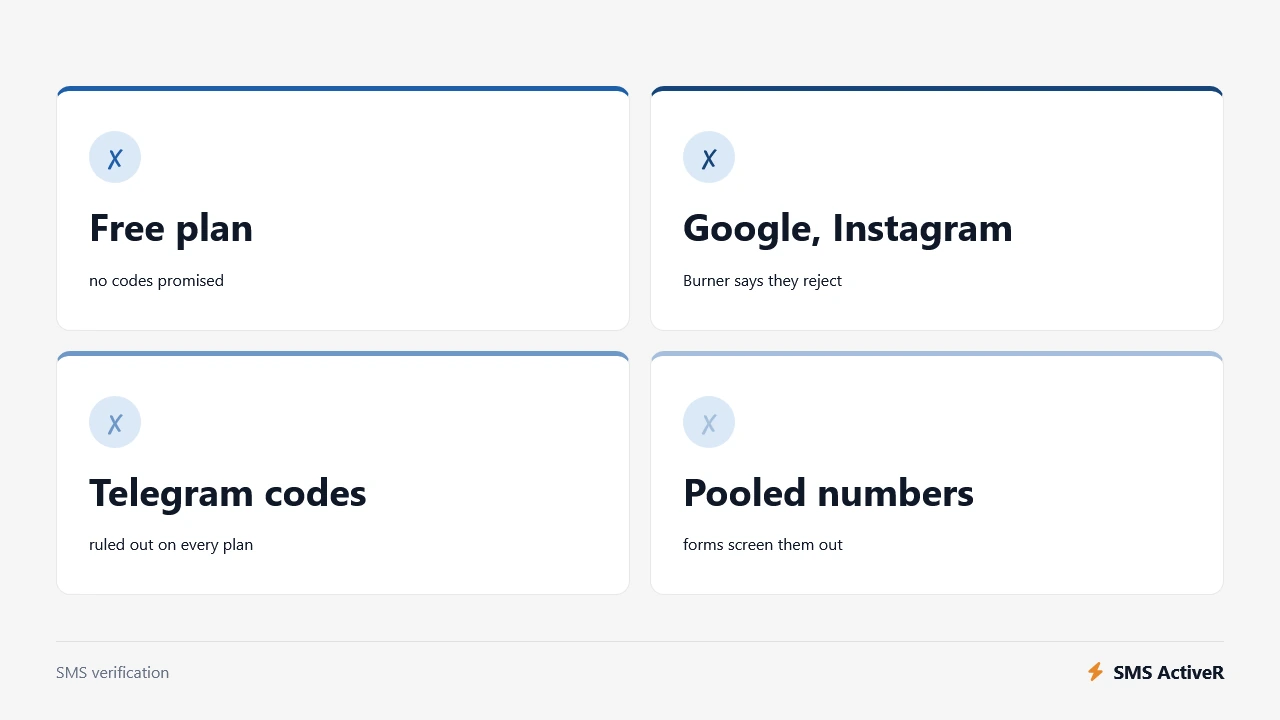
What TextNow says about verification codes in its own help pages
TextNow ties most verification codes to money. Its support article says codes start working once you activate a TextNow SIM card or buy a subscription, and it names the two plans that qualify. A free number carries no such promise. The wording is the company’s own:
You will be able to receive most verification codes by activating a TextNow SIM card or purchasing one of our subscriptions: Lock in Number or Ad-Free+.
— TextNow Help Center
Three limits follow from that page, and each one matters before you attach a number to an account:
- A free number is not promised to receive codes at all.
- Some services reject TextNow numbers for verification whatever you pay — that call belongs to the site, not to TextNow.
- Canadian verification is described as largely unsupported, with the company’s own advice not to buy a subscription for it.
There is a fourth point worth reading. TextNow takes back inactive numbers on its free service. If your number goes back to the pool, you may lose access to accounts tied to it.
Burner, Hushed and Pinger say the same about Google, Instagram and WhatsApp
Every vendor in this category publishes the same warning, which is what makes it a category problem rather than one company’s flaw. Burner, Hushed and Pinger all state that large services may refuse their numbers at sign-up. The wording differs, the message does not:
- Burner warns that sites including Amazon, Google and Instagram may reject its numbers.
- Hushed says its numbers are not guaranteed to work with third-party verification, naming social media, banking, email and apps.
- Pinger, which makes TextFree, rules out Telegram short codes on every plan, free or paid.
Pinger goes further on the big one:
Certain services, such as WhatsApp, may prevent the delivery of verification codes to virtual numbers like ours.
— Pinger, in its TextFree help centre
Hushed also declines to swap a number for free when verification fails. A failed sign-up costs you the number or more money — sometimes both.
Why sign-up forms reject numbers from calling apps
A sign-up form judges the number, not the app. Numbers used by calling apps are pooled, reassigned and free to obtain. That makes them the cheapest way to create accounts in bulk, so big services screen them out.
A number issued by a mobile carrier costs someone money. That is exactly why it passes — and how often it actually passes differs by app and country, which we measured across 541 app-and-country pairs. It also explains the part people find unfair. Paying more inside the same app rarely helps: the paid tier hands you the same kind of number, just with fewer ads.
A temporary number receives a sign-up SMS without any app
If the whole job is one code for one sign-up, you do not need a second number. You need someone else’s number for twenty minutes. Nothing installed, no account kept, and the cost is a fraction of a monthly plan.
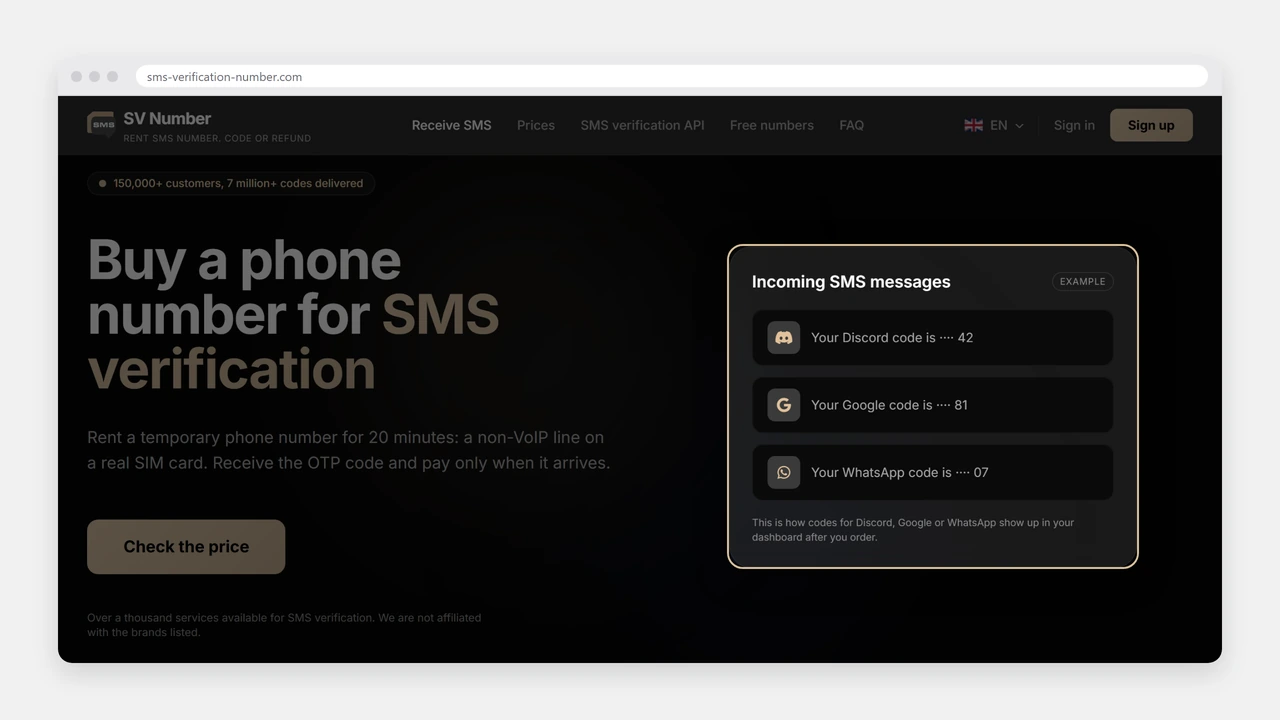
SV Number rents a private number for 20 minutes for $0.99
SV Number (sms-verification-number.com) rents a number from real mobile carriers for 20 minutes, for $0.99. During those minutes the number is yours alone. It is not shared with other people waiting for the same code — which is the usual reason a code lands in someone else’s window.
The whole thing takes four steps:
- Pick the service you are registering for.
- Pick the country the number should come from.
- Enter the number on the sign-up form.
- Read the code on the page. It appears there, not in an app.
There is no subscription and nothing to cancel afterwards. The rental simply ends.
If the code does not arrive, the money returns to your balance
No service can promise that every sign-up goes through. Nobody honest will tell you otherwise. What can be promised is this: you do not pay for a number that failed. If no SMS lands in those 20 minutes, the money goes back to your balance and you try another number.
Compare that with a subscription. A monthly plan charges you the same whether the code arrived or not. And you have already paid for next month while you are still writing to support.
A temporary number receives SMS only and does not make calls
Honest boundary: a rented number takes the sign-up SMS and nothing else. You cannot call from it. You cannot hold a conversation on it. After 20 minutes it is gone.
So the rule is simple. One code, one sign-up, no ongoing relationship with the number — rent it. Calls, chats, a number people ring you back on — buy one of the apps below.
Free apps can replace TextNow for calls and texts over Wi-Fi
For conversation, a free calling app is genuinely useful. Calls and texts over Wi-Fi, no carrier plan, no second phone. What differs is what happens to your number when you go quiet, and how far the free tier goes before it asks for money.
Google Voice: a free US number, reclaimed after inactivity
Google Voice is the closest free equivalent to TextNow for calling. One hard boundary: the personal plan is a US product. Google’s own help page puts it plainly — if you are in the US, you can choose your own number.
Calls from the US to the US and Canada are free. The catch is inactivity. Google reclaims a number that sits unused, and leaves a 45-day window to get it back. For a number attached to your bank or your main email, that window is the whole risk.
For codes it hits the same wall as the rest: WhatsApp turns down most Google Voice numbers. Why that happens, and what to use instead, is in Google Voice and WhatsApp.
TextFree: codes on the paid plan only, Telegram short codes never
TextFree supports verification calls and texts only on a paid subscription. As a free texting app it works fine. As a route to a WhatsApp or Telegram account it is ruled out by Pinger itself, before you spend anything.
TextMe: the code arrives but stays locked until you buy the number
TextMe delivers the code, then holds it behind a purchase. Its support article says you will be asked to buy the number to read the message. Do not buy, and the message expires within 24 hours. The code exists. Reading it costs money.
Dingtone: cheap international calls, but the number stays the company’s property
Dingtone runs on credits. That makes international calling cheap and makes the free tier a treadmill of ads and tasks. The part to read first sits in its own FAQ:
The phone numbers are the property of Dingtone, Inc. We reserve the right to revoke your phone number.
— Dingtone FAQ
Free here means free calls and texts, not a number you keep for nothing
This is the misunderstanding that costs people accounts. In every app above, free covers the talking. The number itself is lent to you while you stay active or keep paying. The code you came for usually sits on the paid side.
Read free as free minutes, not as a free number. Then the choice gets easy. These apps differ mainly in one thing: how long you can stay quiet before the number goes back to the pool.
Paid second-number apps cover calls and chats for months
When the number is for people rather than forms, a subscription is the right buy. It gives you months of calls and texts on a number of your own. Here is what the three main options cost, from their own pricing pages:
| App | Entry price | Annual price | Number countries |
|---|---|---|---|
| Hushed | $6.99/mo | up to 20% off | US, Canada, UK |
| Burner | $7.99/mo | $47.99/year | US, Canada |
| Quo | $19/user | $15/user/mo | US, Canada |
Burner: built for numbers you throw away
Burner’s Standard plan is $7.99 a month, or $47.99 billed yearly. Premium is $12.99 a month and adds video messaging, voicemail transcription and a VPN. Subscribing on the site rather than through the app stores saves 20%.
The product suits listings, dating and one-off deals. Prepaid numbers get deleted after 30 days. Just remember its own warning about Amazon, Google and Instagram before you use it for sign-ups.
Hushed: the cheapest monthly entry, three countries
Hushed starts at $6.99 a month for unlimited local talk and text. Prepaid credits start at $7.99, and a pay-as-you-go plan from $8.99 includes $1 of credit for international calls. Numbers come from Canada, the United States and the UK.
Quo: a work number for a team, not for one person
Quo, formerly OpenPhone, is the business end of this list. It costs $19 per user per month, or $15 on annual billing, with unlimited calling and messaging to US and Canadian numbers. International calls and messages are add-ons, charged per minute and per message.
At three times the price of Hushed you are buying shared inboxes, call summaries and CRM integrations. Worth it for a team. Wasted on a single second number.
The country of the number changes which calls and sign-ups work
Country is the constraint people discover last and pay for first. Every app here issues numbers from a short list of countries. That country decides what your calls cost and whether a local service accepts the number at sign-up.
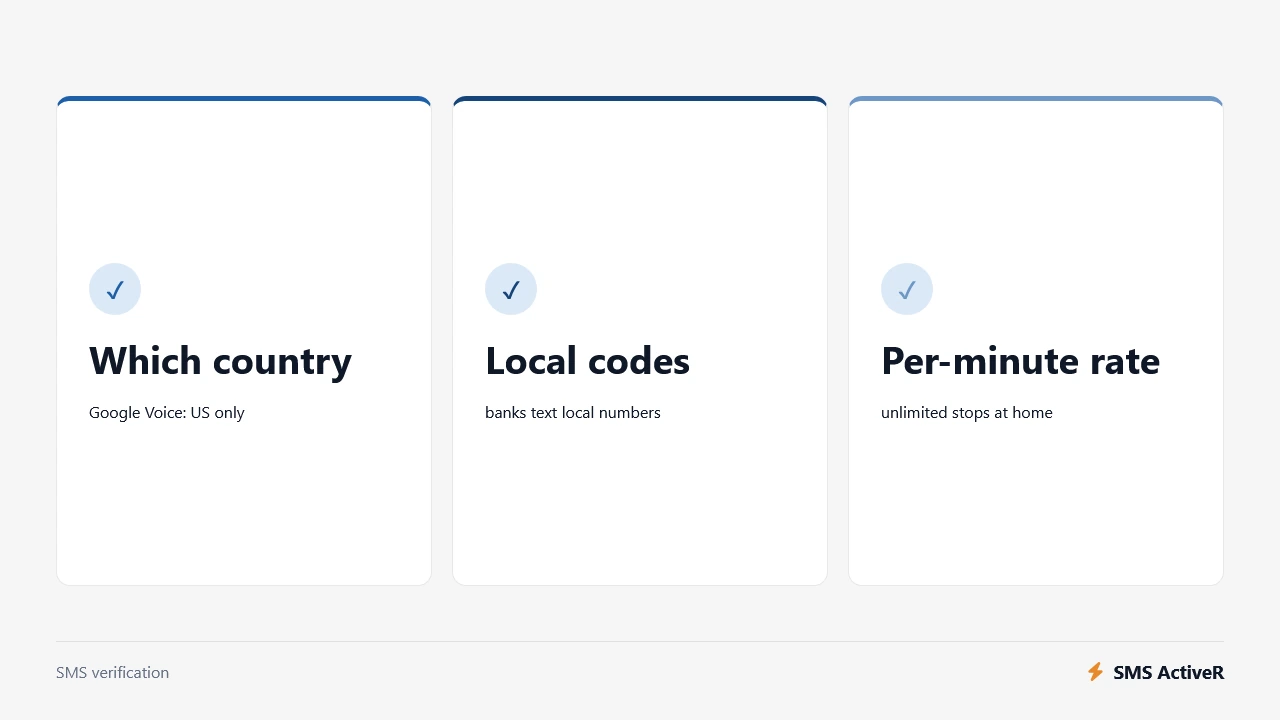
Most of these apps hand out US and Canadian numbers only
Coverage is narrower than the marketing suggests. Google Voice offers its personal plan in the US only, Quo sells US and Canadian numbers, and Hushed is the widest of the three while still stopping at three countries. Country by country, that leaves:
- Google Voice — the personal plan is a US product.
- Quo — US and Canadian numbers as standard.
- Hushed — the widest of them, and it still stops at three countries.
Live outside those countries and a second number from these apps is a foreign number, with everything that follows. A rented number is the opposite case: you pick the country before you pay.
International calling is a separate bill
Unlimited plans are unlimited inside their home countries. Quo charges international calls per minute on top of the subscription. Hushed sells a pay-as-you-go plan for exactly this. Dingtone runs the whole thing on credits.
Work out the per-minute rate to the country you really call. For regular international calls, the monthly price is rarely what decides the bill.
A sign-up form can reject a foreign number even when the app works
Two checks sit between you and an account. First, does the site accept that type of number. Second, does it accept a number from that country. An app can pass the first and fail the second — local banks and delivery services often send codes to local numbers only.
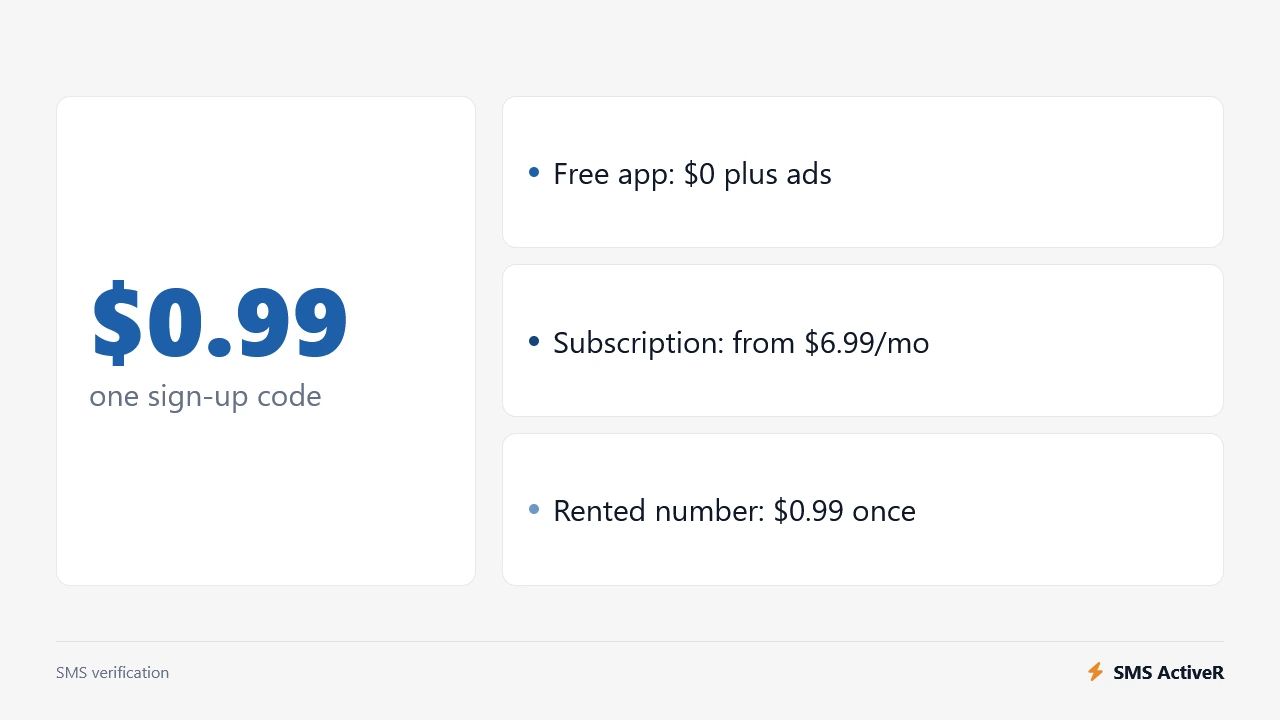
The same job can cost $0 with ads, $6.99 a month, or $0.99 for one code
Put all three routes against one job — finishing a single sign-up — and the gap is wide. The cheapest route by price is not free in practice, and a subscription is an expensive way to solve a problem that lasts twenty minutes.
| Option | Price | Free codes | Countries | If you stop |
|---|---|---|---|---|
| Google Voice | Free | No promise | US | 45-day window |
| TextFree | Free + ads | Paid only | US, CA | With plan |
| TextMe | Free | Locked | n/a | With plan |
| Dingtone | Credits | Varies | n/a | May be revoked |
| Burner | $7.99/mo | Often no | US, CA | 30-day delete |
| Hushed | $6.99/mo | No promise | US, CA, UK | With plan |
| Quo | $19/user | Not offered | US, CA | With plan |
| SV Number | $0.99/rental | Refunded | you choose | Rental ends |
What one code costs on each route
A free app costs $0 and takes payment in ads and tasks, with a decent chance the code never arrives. A subscription costs from $6.99 and charges again next month. A rented number costs $0.99 once, refunded if nothing comes.
The subscription wins only when you keep the number: conversations, callbacks, months of use. For one account it is the worst value here.
What happens to your number if you stop paying
Stop paying, or simply go quiet, and every option treats your number differently. Some reclaim it after a few weeks, some delete it outright, and one states plainly that the number was never yours to begin with. Check this before you attach anything to it:
- Google Voice — reclaims an inactive number, 45 days to get it back.
- TextNow — takes back inactive free numbers, and warns you may lose the accounts tied to them.
- Burner — deletes prepaid numbers after 30 days.
- Dingtone — states the numbers are its property and it may revoke yours.
- A rented number — expires in 20 minutes by design, with nothing attached to it.
Questions people ask about TextNow alternatives
These questions come up in every thread about TextNow. Most have a documented answer rather than an opinion, so where a company states something about its own service, that statement is used here.
What is the best free TextNow alternative?
For calling in the US, Google Voice. It is free, it uses the Google account you already have, and calls to the US and Canada cost nothing. For texting on a budget, TextFree. Neither is a free route to verification codes.
Can I use a TextNow number for WhatsApp?
Often not. TextNow says some services do not support its numbers for verification, and Pinger names WhatsApp outright as one that may block delivery. For a WhatsApp sign-up, a number from a mobile carrier is the one built for the job.
Can these apps receive verification codes at all?
Sometimes — on the paid tier, for services that do not screen number types. TextNow ties most codes to its SIM or a subscription. TextFree supports them on a paid plan only. TextMe makes you buy the number to read the message.
Is TextNow free?
Calls and texts are free with ads, and that part is genuine. Codes are the paid part, and inactivity costs you the number. Free covers the talking, not the number and not the code.
Which TextNow alternative works in Canada?
Hushed sells Canadian numbers, and Quo covers them on every plan. For codes specifically, TextNow itself calls Canadian verification largely unsupported — so paying it for that purpose goes against the vendor’s own advice.
Is there a TextNow alternative for a PC?
Google Voice runs in a browser, and Quo has a desktop app. A rented number needs no software at all: the code appears on the page you rented it on. That makes it the simplest option at a computer without your phone.
Is there a TextNow alternative without ads?
Any paid tier removes ads — Burner from $7.99 a month, Hushed from $6.99, TextNow’s own Ad-Free+ plan. If the ads annoy you only because you are hunting one code, the cheaper fix is not to pay monthly at all.